 EN
 DE
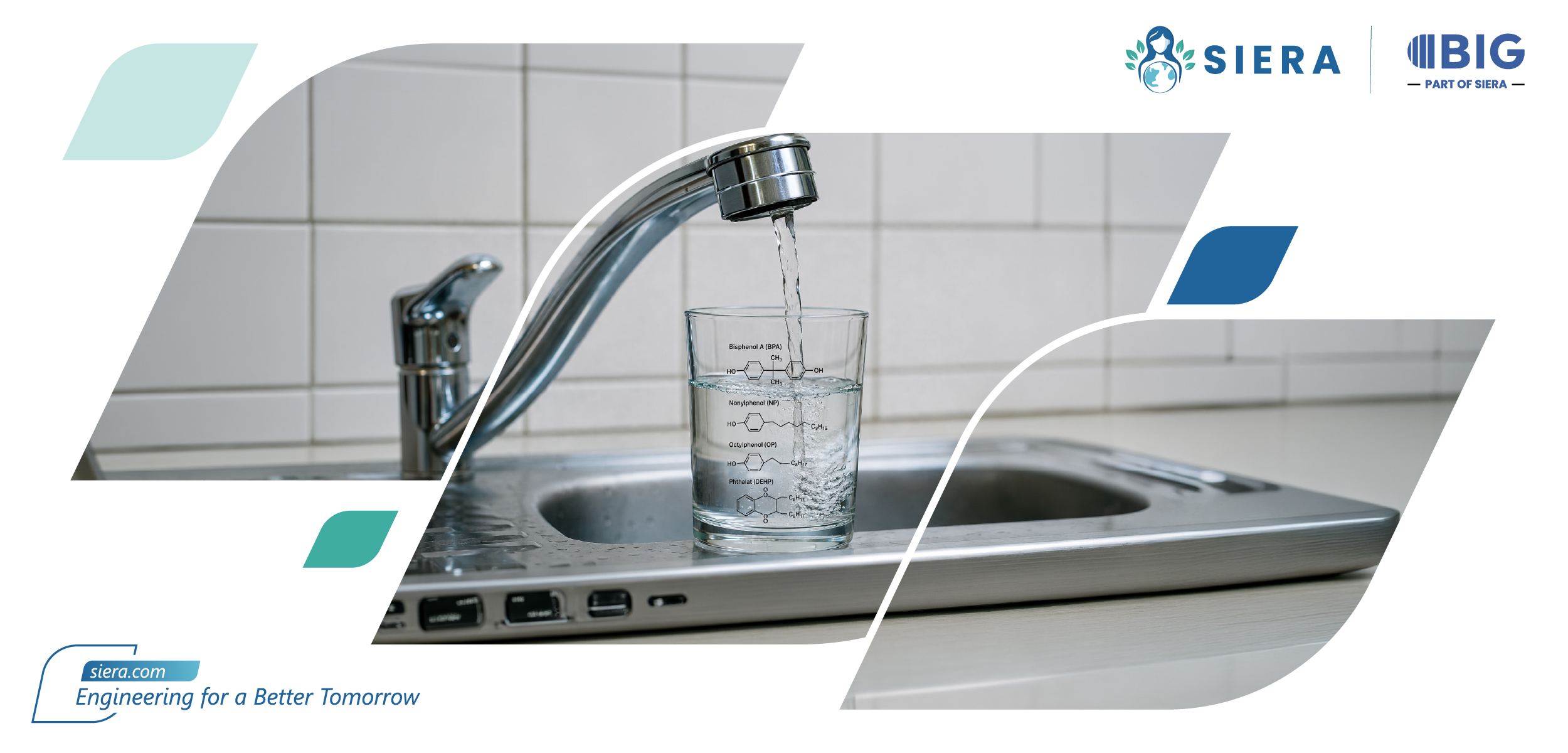
Clean drinking water requires proactive protection
Climate change is increasing the pressure on water resources. At the same time, substances from our everyday lives are entering the environment via wastewater and other pathways. To ensure the long-term protection of drinking water, it is therefore crucial to identify sources of pollution at an early stage and to carry out a technical assessment of their potential consequences.
Among the substances that deserve particular attention are endocrine disruptors. They can disrupt the endocrine system in humans or animals. Assessing them is a complex task: the effect depends, amongst other things, on the specific substance, its concentration, the duration of exposure and the organism’s sensitive life stage.
For Prof. Burmeier Ingenieurgesellschaft mbH - Part of SIERA – the protection of natural resources is linked to responsible environmental engineering. The question of how water bodies and drinking water can be protected in the long term illustrates why research, reliable data and precautionary measures go hand in hand.
How do trace substances end up in water bodies?
Chemical substances from medicines, consumer products, agriculture and industrial applications can enter surface water and groundwater in various ways. One route of entry is through wastewater. Conventional sewage treatment works remove many pollutants, but are not designed to completely retain every synthetic compound.
The groups of substances examined in water quality tests include, amongst others, pharmaceutical residues, X-ray contrast agents and endocrine-disrupting substances. Whether a substance is subsequently found in the Drinking water However, whether this occurs depends on many other factors: for example, water abstraction, the properties of the substance and the treatment process.
The detection of a substance in waste water or river water does not therefore automatically mean that the same substance is also present in drinking water. Nor can a direct health risk be inferred simply from the detection of a very small quantity. This requires a substance-specific assessment of actual exposure.
What are endocrine disruptors?
The endocrine system regulates numerous processes in the body, including development, metabolism and reproduction. Certain substances can interfere with these signalling pathways. From a endocrine disruptor This term is used when a hormonal effect is associated with an adverse effect on an organism or its offspring. Not every hormonally active substance is therefore automatically classified as an endocrine disruptor.
Well-known or widely discussed substances with endocrine-disrupting effects include, for example, bisphenol A, certain phthalates and some persistent industrial chemicals. It is important to note that groups of substances such as PFAS or polychlorinated biphenyls must not be treated as one and the same across the board. Their properties and effects must be assessed on a case-by-case basis for each individual substance.
Particular attention must be paid to potential effects during sensitive stages of development. Furthermore, effects may not become apparent immediately. The combined exposure to several substances is also an important area of research. These uncertainties call for careful assessment – not for the blanket assumption that every instance of detection constitutes a health risk.
Why are impacts on water bodies particularly relevant?
For aquatic organisms, endocrine-disrupting substances can have an effect even at very low concentrations. The The Federal Environment Agency describes For example, studies in which endocrine-disrupting chemicals have affected the reproductive capacity of fish and amphibians. Changes have also been observed in fish downstream of sewage treatment plant discharges.
Findings such as these provide important insights for the protection of water bodies. However, they cannot simply be applied to the health assessment of treated drinking water. Aquatic ecology and drinking water safety involve different routes of exposure and assessment criteria.
| Question | Implications for the assessment |
| Where has a substance been detected? | Wastewater, surface water, groundwater and drinking water must be considered separately. |
| What is its concentration? | Evidence alone does not in itself indicate a possible effect. |
| What are the properties of the fabric? | Persistence, mobility and hormonal effects may be relevant to the assessment. |
| Who or what is affected? | The effects on aquatic organisms and the risks to humans are assessed differently. |
| What information is missing? | Research and monitoring help to reduce uncertainties in a targeted manner. |
What do analytics and monitoring achieve?
Thanks to advances in analytical methods, it is now possible to detect many trace substances at very low concentrations. This improves our understanding of which substances are present in water bodies and how their levels are changing.
However, measured values must be interpreted in context. Factors such as the quality of the sampling, the method’s limit of quantification, repeated measurements and knowledge of the effects of the substance in question are important in this regard. Monitoring reveals trends; a technical risk assessment explains what the results might mean.
Further research is particularly necessary in the case of substances with potential endocrine-disrupting effects. It helps to improve our understanding of mechanisms of action, to further develop suitable testing methods and to review regulations on a sound scientific basis.
How does the EU support the protection of drinking water?
The revised EU Drinking Water Directive came into force on 12 January 2021. Among other things, it sets a parametric value for bisphenol A and establishes a watch list for emerging substances. This includes substances that are subject to particular scrutiny due to their potential endocrine-disrupting effects.
European chemicals legislation also addresses endocrine disruptors. The measures applicable to a substance depend on its scientific assessment and the relevant legal framework. It would therefore be incorrect to claim that all substances with hormonal effects are, as a matter of principle, banned or may only be used in exceptional circumstances.
Prevention starts before water treatment
The best way to protect drinking water in the long term is to reduce inputs as early as possible in the material cycle. This requires several coordinated approaches:
- Identifying and assessing substances: Research helps to identify relevant effects and pathways of entry.
- Reduce entries at source: Where suitable alternatives are available, the use of problematic substances can be reduced.
- Monitoring water bodies and drinking water: Targeted monitoring provides data for assessment and prevention.
- Further developing wastewater treatment: Depending on the location and the objective, additional treatment stages may be more effective at retaining certain trace substances.
- Applying insights to decision-making: Science and regulation must continually take new findings into account.
None of these measures can tackle the challenge on its own. Together, they can help to protect surface water and groundwater and safeguard the quality of drinking water in the long term.
Responsibility for a valuable resource
Endocrine disruptors demonstrate just how closely chemical management, water protection and drinking water safety are interlinked. It is crucial to adopt an objective perspective: taking potential effects seriously, carefully evaluating the evidence and basing measures on robust findings.
In the context of SIERA makes Prof. Burmeier Ingenieurgesellschaft mbH - Part of SIERA – highlights the importance of responsible environmental engineering for the protection of our natural resources.
Sources and further information
- Federal Environment Agency: Endocrine disruptors
- Federal Environment Agency: Environmental impacts of pharmaceutical substances
- Federal Institute for Risk Assessment: Questions and Answers on Endocrine Disruptors
- EU Drinking Water Directive (EU) 2020/2184
CTA
Would you like to find out more about how responsible environmental engineering helps to protect water resources? Discover the work of Prof. Burmeier Ingenieurgesellschaft mbH - Part of SIERA – and get in touch to discuss any questions you may have about water and environmental protection.
Engineering for a Better Tomorrow